
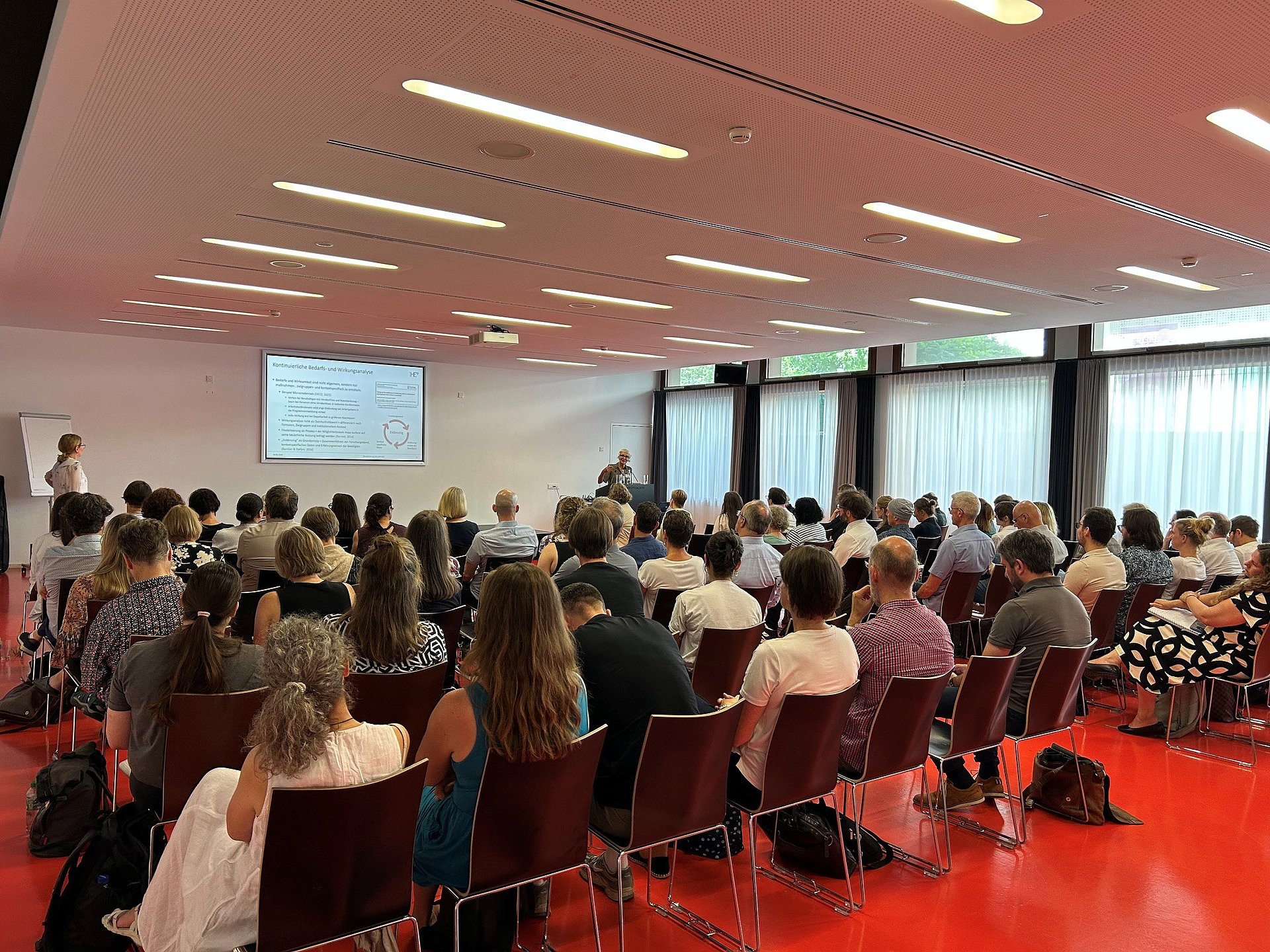
Part-time study and flexible study structures are becoming increasingly important in light of diverse educational backgrounds, family commitments and the growing significance of lifelong learning. Against this backdrop, the conference ‘Part-time study and flexible study structures’ took place on 18 June 2026 at the Evangelisches Bildungszentrum Hospitalhof in Stuttgart. Around 90 participants from higher education institutions in Baden-Württemberg took the opportunity to discuss current developments, successful practical examples and future prospects for flexible study models.
The importance of this topic is growing: the student body is becoming more diverse, educational pathways more individualised, and the demands of lifelong learning are increasing. At the same time, higher education institutions face challenges such as a shortage of skilled workers and demographic change. Flexible study formats and part-time study programmes are therefore becoming increasingly important in promoting academic success and equal opportunities.
The conference was aimed at stakeholders from university management, administration, teaching, curriculum development, higher education pedagogy and digitalisation. The focus was on tried-and-tested concepts, best-practice examples from Baden-Württemberg and other federal states, and the question of how flexibility in study and teaching can be sustainably embedded.
Dr Elke Bosse from the HIS Institute for Higher Education Development e. V. opened the proceedings with her keynote address, ‘Flexibility as a guiding principle of teaching development’. She demonstrated how different forms of flexibility can be systematically categorised and what conditions are necessary for their successful implementation. Prof. Dr Stephanie Hanrath and Christine Niksch from the Technical University of Central Hesse then presented the ‘QuIS Flex in Hessen’ project, sharing experiences from a state-wide initiative that opens up new scope for students.
Three parallel workshops explored key areas of action relating to flexible study structures in greater depth. In the workshop ‘Flexibility in Terms of Time and Location’, Dr Imke Buß discussed ways of adapting study programmes more closely to students’ different life situations. The focus was particularly on approaches to achieving greater flexibility in terms of time and location across various degree programmes.
The workshop ‘Part-time study: models, insights and success factors’ presented various approaches from Baden-Württemberg. Presentations included the Konstanz model ‘Studying Part-time’ by Dr Melanie Seiß and Lara Williams; the ‘Individual Part-time’ programme at Albstadt-Sigmaringen University by Christiane Lieb and Benjamin Hesse; and the part-time study programmes at the University of Heidelberg by Christoph Schlomach and Julia Heyne. The discussion highlighted both the potential and the challenges involved in implementing part-time study programmes.
There was also particular interest in innovative approaches to a more flexible start to studies and the organisation of the introductory phase. Manuela Moll presented the ‘startING’ introductory semester at Offenburg University of Applied Sciences; Andrea Nitsche presented the flexible study model run jointly by the University of Stuttgart and the Karlsruhe Institute of Technology; and Nadine Hecht and Katharina Wittemann presented the ‘KATAPULT’ preparatory course in design at Pforzheim University. These examples highlighted different ways of supporting prospective and first-year students in their transition to higher education and of promoting individual learning pathways. In the ensuing discussions, the potential, challenges and prerequisites for successful implementation at various higher education institutions were explored.
The conference made it clear that flexibility extends far beyond organisational adjustments. It concerns fundamental issues of teaching development, the organisation of studies, student guidance and curriculum design. At the same time, it became apparent that flexible study programmes are particularly effective when they are strategically embedded, communicated transparently and supported by appropriate advisory and support services.
To conclude, the day’s findings were summarised and prospects for the further development of flexible study programmes were discussed. The high level of participation underlines the considerable interest shown by higher education institutions in this topic. The conference thus provided important impetus for the further development of part-time study and flexible study structures in Baden-Württemberg.
The conference documentation is available to staff at state and state-recognised higher education institutions in Baden-Württemberg on the digital platform bw Campus Community (https://campuscomm.de/media_center/folder/2335ea25-e008-4694-b33f-82c4157a1a9e; access requires a registered account).
We warmly invite all members of the higher education community in Baden-Württemberg to continue the discussions initiated there!